

Our whole reason for being is to support your organization and its people to be “future ready humans”. What does that mean?
We often tell the anecdote of being marched down to the resource centre in our small town elementary school one day, the year prior to heading to high school. The librarian pulled down a huge number of binders that normally sat dusty on the top shelf, thumping them down on the desk in front of us.
“These are ALL THE JOBS IN THE WORLD!”, she announced with a sweeping arm gesture as we all stared wide-eyed at our futures.
The binders were, of course, a resource provided by the government about the various types of industries and jobs out there, what Canada now calls the National Occupational Classification (NOC). They were intended to be helpful, but the prospect of picking one (or several) future role was daunting. What if I don’t succeed? Or what if I don’t like it once I’ve spent the next several years getting there?
For all in that class of 30 or so (yes, small town indeed!), we proceeded on our various career paths. Some stopped their learning early. Others went to trades. Still others — thinking we were in the elite group — headed off to post-secondary and even graduate education. All of us got jobs of one sort or another, but where did we ACTUALLY wind up?
Years later, during my Master’s program, I was exposed to the 1991 book by Robert Reich, a well-known academic and then Secretary of Labor for the 2nd Clinton administration: The Work of Nations: Preparing Ourselves for 21st Century Capitalism (ISBN 0-679-73615-8). It was an eye-opening read, coming as it did after my family’s business of some 30 years had gone bankrupt in the face of deregulation in the trucking industry in Ontario, and many other businesses seemed to be failing with alarming frequency.
Right or wrong, a central tenet of the book was that the age of the life-long career with a single company was either gone or fast fading. There wouldn’t be a gold watch and a peaceful retirement (short or long… no one knows) at the end of the journey. Instead, the book asserted that people of my generation could expect to have multiple career paths and many jobs in our working lives. Sound familiar to many?
The world was also going to be divided into two main categories of workers: symbolic analysts (like me?) who would be rewarded in their careers for coming up with new ideas and being creative, and repetitive task workers (doesn’t the title say it all?) who sounded like the robotniks from a dystopian future, but essentially anyone who wasn’t writing the rules for future work.
That was long before automation and artificial intelligence arrived on the scene with a storm, but even in the intervening years we were dealing with a growing number of enterprise resource planning systems and corporate tools that were sorting the world out into those who decided the rules and those who followed them. Today the situation is even more stark: up to 46% of the jobs in OECD countries are at risk of being replaced through automation, and that’s now accelerating with the rise of AI as part of our daily world (no, AI is not writing this post, thank you very much).
In that type of world, skills become the dominant currency for successful careers. Where you went to school and what you took still matter to a degree, but if you’re not upskilling and reskilling constantly, you’re inevitably going to fall behind. Where skills once had a half-life (the point where a given skill loses half of its value and relevance) measured in decades, the average half-life for most skills is now less than five years. It’s even shorter in more technical fields, hovering around three years.
For a place like Calgary, and across the wider lens of Alberta, that’s a daunting picture.
We’re home to some of Canada’s top engineering and STEM talent, but they’re often working in industries that are rapidly declining or subject to a great deal of volatility (try being a geologist in today’s workforce).
Fortunately, we have a committed group of individuals and institutions who have formed the LearningCITY Collective to build a coherent approach for how we can deal with the learning challenges of today and tomorrow and stay competitive.
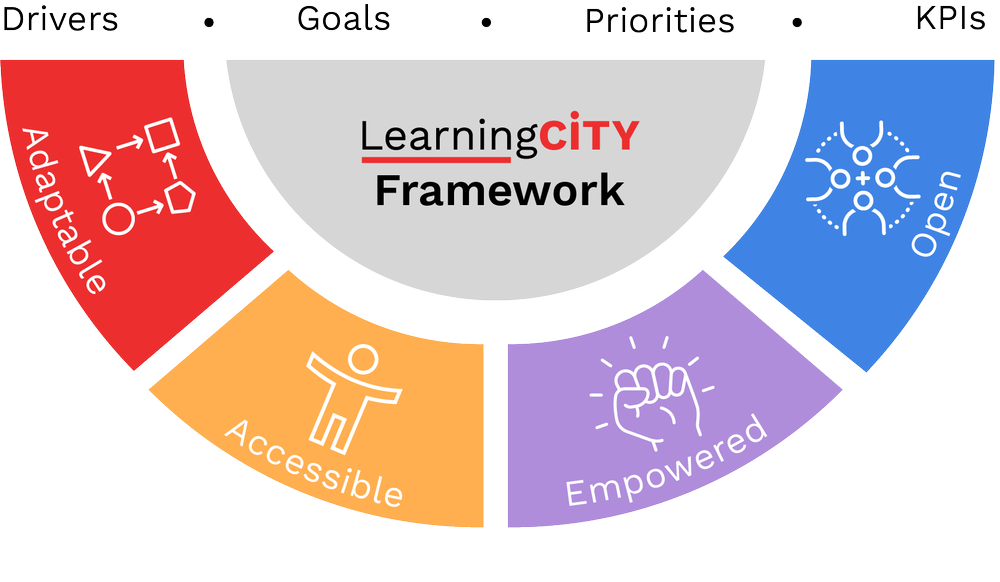
A key component of that is the LearningCITY Framework (see diagram), which tries to give expression to the attributes that anyone, in any industry or role, will need to keep in front of them as they continue their working career. And no, the future doesn’t care whether you’re a symbolic analyst or a repetitive task worker: EVERYONE needs to keep upskilling and reskilling.
In the end, being a “future ready human” is equal parts mindset and capability (more on that in another post). There is no one magic bullet way of getting there, and it takes constant effort to stay relevant in today’s business environment. That’s actually not new: it just has a much shorter life-span than it ever has in past.